
- Why Greenhouse Size Matters More Than You Might Think
- Start With How You Will Use the Greenhouse
- Common Greenhouse Sizes and What They Can Handle
- How Much Growing Space Do You Actually Need?
- Don’t Confuse Floor Area With Growing Area
- Width vs. Length: Which Dimension Matters More?
- Choose Your Size Based on the Crops You Grow
- How Climate and USDA Zone Affect Greenhouse Size
- Size for the Season You Actually Want to Grow
- When a Small Greenhouse Is Enough
- When It Makes Sense to Go Larger
- Plan for Future Growing, Not Just This Year’s Garden
- Common Greenhouse Sizing Mistakes
- A Simple Method for Choosing Your Greenhouse Size
- Real-World Greenhouse Size Examples
- Final Greenhouse Sizing Checklist
- Greenhouse Size FAQ
Why Greenhouse Size Matters More Than You Might Think
When people first shop for a greenhouse, the most obvious question is often, “What size will fit in my yard?” Experienced growers usually approach the decision from the opposite direction: What do I want to accomplish inside it?
A greenhouse that is technically large enough for a few tomato plants can still feel cramped once you add a walkway, shelving, seed-starting trays, irrigation equipment, and enough working room to move around without brushing against plants. Conversely, a very large greenhouse may be unnecessary if your goal is simply to start seedlings in spring and protect a few warm-season crops from cool nights.
That is why greenhouse size should be treated as a planning decision rather than simply a measurement.
The right structure should give you enough room for your plants and the way you actually garden. It should also leave enough space for the air circulation, access, maintenance, and seasonal changes that make a growing area practical.
The best greenhouse size is not the largest one you can fit on your property. It is the smallest size that comfortably supports your intended crops, layout, equipment, growing season, and likely future needs.
Start With How You Will Use the Greenhouse
Before comparing dimensions, define the job your greenhouse needs to perform. Different goals can require surprisingly different amounts of space.
Seed starting and transplant production
If your primary goal is to start vegetable, flower, or herb seedlings before moving them outdoors, you may not need a large floor area.
Seedlings can be grown densely on shelves or benches because they occupy relatively little space during their early stages. In this situation, vertical space and usable bench area may matter more than a large footprint.
However, seed starting often becomes the gateway to broader greenhouse use. Gardeners who initially want a place for trays of seedlings frequently discover that they also want to overwinter plants, grow greens, raise tomatoes, or maintain a collection of herbs.
If that sounds likely, sizing only for seed trays can result in a greenhouse that feels too small within a year or two.
Season extension
Season extension means using a protected growing environment to begin crops earlier in spring, continue production later in fall, or sometimes grow through winter.
This does not necessarily mean producing crops all year. A gardener in USDA Zone 5, for example, may use a greenhouse to get a head start on tomatoes and peppers in spring and continue growing greens after outdoor conditions become unfavorable.
That type of use generally benefits from more room than a simple seed-starting setup because mature plants occupy much more space.
Growing food through winter
Winter production changes the calculation again. Once the greenhouse is expected to support crops during cold weather, you may need room for insulation strategies, supplemental lighting, heating equipment, thermal mass, or additional ventilation and environmental-control equipment.
The greenhouse is no longer just plant space. It becomes a managed growing environment.
A larger structure can make that environment easier to organize, but it also increases the volume that may need to be heated or otherwise managed. Bigger is therefore not automatically better for winter growing.
Growing large summer crops
Tomatoes, cucumbers, melons, and other vigorous crops can consume considerably more space than their young plants suggest.
Indeterminate tomatoes, for example, continue producing new stems throughout the season and are commonly trained vertically. Cucumbers can develop a substantial canopy when grown on trellises. Their floor footprint may look modest, but their leaves, fruit, and support systems can extend well beyond the original planting point.
If these are your main crops, plan around the mature plants rather than the seedlings you will put into the greenhouse in April.
Common Greenhouse Sizes and What They Can Handle
There is no universal “correct” greenhouse size, but common dimensions provide useful reference points.
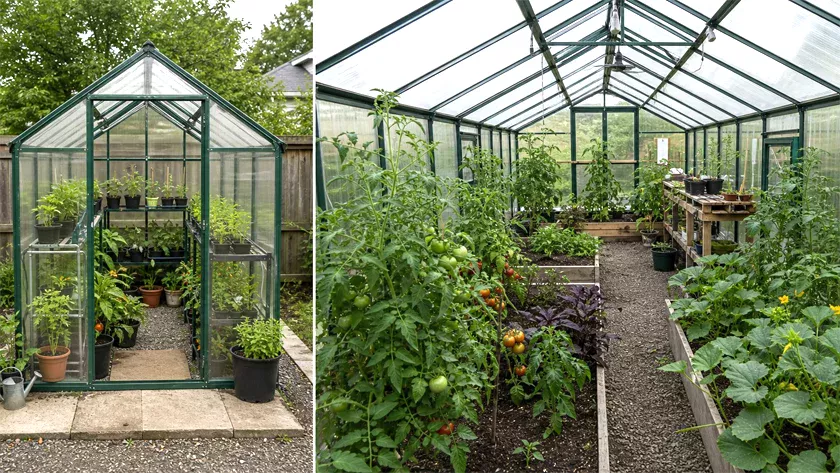
For backyard growers, sizes in the neighborhood of 7 × 12 feet, 9 × 12 feet, 9 × 14 feet, 9 × 21 feet, and larger can serve very different purposes. A 12-foot-wide greenhouse can provide still more flexibility for multiple beds and wider working paths.
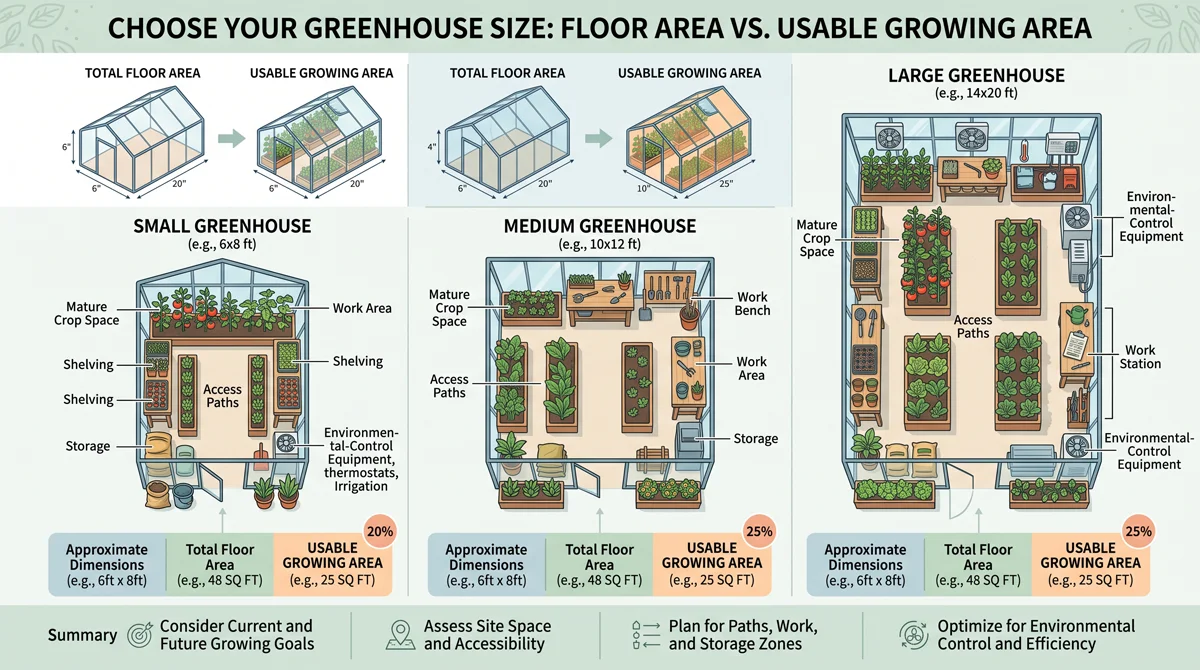
Remember that the numbers describe the outside footprint, not the amount of open planting space you will have after installing beds, benches, shelving, doors, and paths.
Small greenhouse: roughly 6 × 8 to 8 × 12 feet
A small greenhouse can work well for gardeners who primarily want:
- spring seed starting
- herbs and greens
- a limited number of tomatoes or peppers
- plant propagation
- protection from spring and fall weather
- a compact growing area close to the house
The main limitation is not necessarily the number of plants. It is flexibility. Once you add a work surface, shelves, containers, and a walkway, the remaining space can disappear quickly.
Medium greenhouse: roughly 9 × 12 to 9 × 21 feet
This range is often more versatile for serious backyard food production.
A medium greenhouse can provide enough floor area to separate crops, create a usable central path, incorporate raised beds or ground beds, and reserve some room for propagation or storage.
The longer footprint is especially useful for growers who want to maintain a succession of crops rather than fill the entire greenhouse with one planting.
Large greenhouse: approximately 10 × 20 feet and beyond
Larger structures become useful when greenhouse growing is a significant part of the household’s food production or when several functions need to coexist.
You may be able to dedicate one section to tomatoes, another to cucumbers or peppers, and another to seedlings, greens, or overwintering plants. A larger footprint can also make it easier to create comfortable working areas without sacrificing growing space.
At this scale, however, site preparation, ventilation, irrigation, heating, snow or wind considerations, and ongoing maintenance become increasingly important.
How Much Growing Space Do You Actually Need?
There is no single reliable number of square feet per plant because spacing depends on the crop variety, training method, container size, pruning, light conditions, and whether plants are grown intensively.
Instead of asking, “How many plants fit in this greenhouse?” ask three questions:
- How large will each crop become?
- How will I train or support it?
- How much space do I need to reach the plants comfortably?
That third question is frequently overlooked.
A tomato plant may physically fit in a narrow strip, but that does not mean the arrangement is practical. You still need to inspect leaves, tie stems, harvest fruit, remove damaged growth, water the root zone, and eventually remove the plant.
Growing density should therefore be based on usable production space, not maximum theoretical plant density.
Think in terms of growing zones
For planning purposes, divide the greenhouse into functional areas:
- Production space: where mature crops grow.
- Access space: paths that allow you to reach plants.
- Work space: an area for potting, transplanting, pruning, and harvesting.
- Storage space: shelves, containers, tools, fertilizers, or irrigation supplies.
- Equipment space: fans, heaters, water tanks, or other environmental-control equipment.
You may not need a dedicated area for every category, but every activity still requires physical room somewhere.
Don’t Confuse Floor Area With Growing Area
Two greenhouses with the same floor area can feel completely different inside.
Consider a 9 × 14-foot structure. Its footprint is 126 square feet. That sounds substantial until you subtract the space occupied by beds, paths, shelving, doors, and working areas.
The important question is not whether 126 square feet sounds large. It is whether your planned layout leaves enough room to grow and work comfortably.
A narrow greenhouse may encourage a single central walkway with planting beds on both sides. A wider greenhouse can make room for multiple beds, a wider aisle, or a central work area.
Vertical growing changes the equation too. Trellising tomatoes and cucumbers allows you to use overhead space, but the plants still require room at the base and adequate clearance around their foliage.
Width vs. Length: Which Dimension Matters More?
When comparing greenhouse sizes, gardeners often focus on total square footage. Width deserves more attention than it usually receives.
Additional length is useful because it gives you more room to add planting sections along the same general layout. Additional width can change the entire interior arrangement.
A wider greenhouse may allow:
- two or more substantial planting beds
- a more comfortable central walkway
- bench or shelf space
- better separation between crops
- room for a dedicated work area
- more flexible future layouts
This is particularly important if you expect to grow both tall crops and low crops, or if you want to combine beds with containers and shelving.
Length is often easier to use incrementally. Width can determine whether a particular layout is possible at all.
For that reason, do not automatically choose a long, narrow structure simply because it provides more total square footage.
Choose Your Size Based on the Crops You Grow
Your crop list is one of the best tools for determining greenhouse size.
Tomatoes
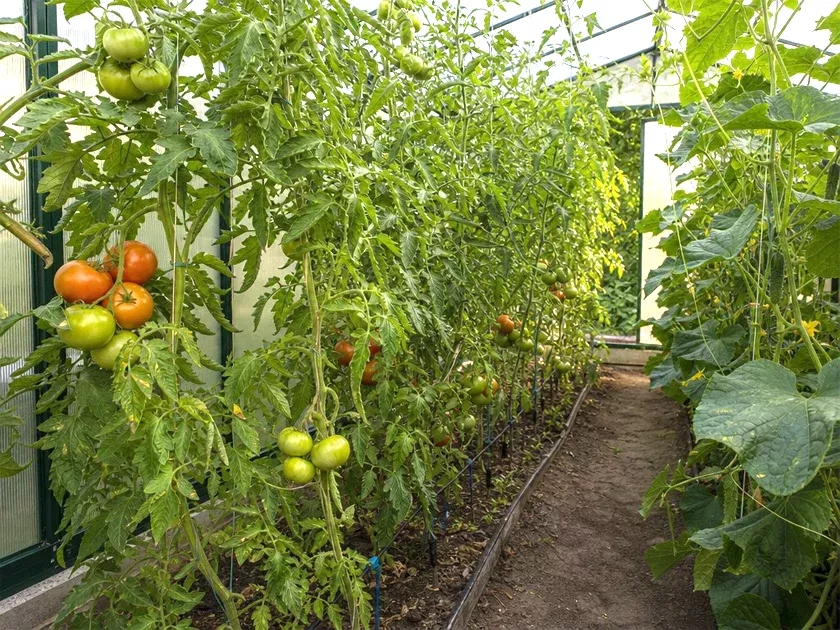
Tomatoes are among the easiest crops to underestimate because a small transplant can eventually become a large vertical plant.
If you grow indeterminate varieties, plan for their mature height, support system, and access for pruning and harvesting. Multiple plants also create a dense canopy, so adequate spacing and air movement become increasingly important as the season progresses.
Cucumbers
Cucumbers can make efficient use of vertical space when trellised, but their foliage can become expansive. Plan for the canopy rather than the stem’s small footprint.
Peppers
Peppers generally have a more compact architecture than large indeterminate tomatoes, making them easier to fit into a relatively small greenhouse.
Leafy greens
Lettuce, spinach, arugula, and similar cool-season crops can be highly space-efficient, especially when grown in succession. A greenhouse devoted primarily to greens can therefore have a different ideal size from one intended for large summer vines.
Seedlings
Seedlings can be grown densely, particularly on shelving or benches. But remember that trays are only part of the seasonal picture. If those seedlings will eventually be moved outdoors, the greenhouse may not need to accommodate them at mature size.
Perennial or overwintering plants
Plants that remain in the greenhouse for long periods require more permanent space. Containers also need room around them for watering, pruning, inspection, and movement.
How Climate and USDA Zone Affect Greenhouse Size
Greenhouse size should not be separated from climate.
The USDA Plant Hardiness Zone Map is based on average annual extreme minimum winter temperatures and divides the United States into zones and half-zones. The current map uses 1991–2020 climate data and is a useful starting point for understanding winter cold in your location.
But hardiness zone is only one piece of greenhouse planning.
A gardener in Minnesota, for example, may use a greenhouse primarily to extend the spring and fall seasons or grow cold-tolerant crops during winter. A gardener in Florida may have the opposite problem: keeping a greenhouse from becoming excessively hot.
In warmer regions, additional greenhouse area can provide more flexibility for ventilation and crop separation, but a larger structure can also contain more hot air and require more careful environmental management.
In colder regions, a larger greenhouse gives you more working and growing space, but if you intend to heat it, the additional volume also represents additional energy demand.
Regional climate therefore influences not only the size you can use, but the size you can reasonably manage.
Size for the Season You Actually Want to Grow
One of the most important sizing decisions is whether the greenhouse will be used seasonally or continuously.
A greenhouse used from March through June may be able to operate with a compact layout because many plants will leave the structure once outdoor conditions improve.
A greenhouse used from early spring through late fall has to accommodate multiple crop stages at once. Seedlings may be starting while mature summer crops are still producing. Fall greens may be planted before summer crops are removed.
Winter production creates another layer of complexity because the greenhouse may need to hold crops for much longer periods.
This is why two gardeners with identical yards can reasonably choose very different greenhouse sizes.
The first may need a compact structure for spring propagation. The second may need enough room to maintain continuous production for much of the year.
When a Small Greenhouse Is Enough
A smaller greenhouse can be an excellent choice when your growing goals are focused.
Consider staying small if:
- you are new to greenhouse growing
- you primarily want to start seedlings
- you grow a modest number of warm-season crops
- your outdoor garden already supplies most of your food
- you have limited space or a difficult site
- you do not plan to heat the greenhouse during winter
- you prefer intensive hands-on growing rather than maximum production
The advantage is simplicity. There is less space to irrigate, ventilate, clean, organize, and maintain.
A small greenhouse can also be easier to monitor because you can quickly see changes in plant health, humidity, temperature, or irrigation.
The trade-off is that small structures reach their limits quickly when several growing functions compete for the same space.
When It Makes Sense to Go Larger
A larger greenhouse is worth considering when you already know that you will use the additional space.
Strong reasons to size up include:
- you grow a large amount of food for your household
- you want to grow several crops simultaneously
- you need room for seedlings and mature crops at the same time
- you want permanent beds plus shelving or benches
- you grow vigorous vining crops
- you want a comfortable work area inside
- you expect your greenhouse use to expand
There is also a practical human factor: comfortable space encourages better maintenance.
If you have to squeeze between plants to reach the back of a bed, routine tasks become unpleasant. When pruning, harvesting, checking for pests, or watering becomes difficult, those tasks are more likely to be delayed.
A little extra working room can therefore have value beyond the number of plants it allows.
Plan for Future Growing, Not Just This Year’s Garden
Greenhouses tend to change purpose over time.
A gardener may begin with six tomato plants and a few trays of seedlings. The following year, they may want winter greens. Later, they may add peppers, cucumbers, propagation benches, or a dedicated space for starting transplants.
This does not mean you should automatically buy the biggest greenhouse available. It means you should distinguish between temporary enthusiasm and a realistic long-term growing plan.
A useful rule is to size for the activities you are reasonably confident you will continue, while allowing some flexibility for expansion.
If you are certain that greenhouse growing will become a major part of your garden, choosing the smallest possible structure can be false economy. If you are experimenting for the first time, a manageable structure may be the better investment.
Common Greenhouse Sizing Mistakes
Choosing based only on available yard space
The largest structure that fits your property is not necessarily the best one. Site orientation, access, drainage, wind exposure, snow loads, utility access, and proximity to the house can all matter.
Planning for seedlings instead of mature plants
A greenhouse can look almost empty in April and completely full by July. Always visualize the largest expected plants at their mature size.
Forgetting paths
A greenhouse without practical access is difficult to manage. You need room to walk, harvest, inspect plants, and move supplies.
Ignoring equipment
Fans, heaters, irrigation equipment, shelves, water containers, and other supplies occupy real space. They also need to be positioned where they can be accessed and maintained.
Assuming more square footage solves climate problems
A larger greenhouse does not automatically provide better temperature control. Ventilation, shading, air circulation, thermal management, and site conditions remain important.
Choosing a long greenhouse when width is the real limitation
Adding length can increase production area, but it may not solve a layout problem caused by insufficient width. Sketch the interior before deciding which dimension you need more of.
A Simple Method for Choosing Your Greenhouse Size
If you want a practical answer rather than a generic size chart, work through this process.
Step 1: Write down your crops
List the plants you genuinely expect to grow under cover. Separate large crops such as tomatoes and cucumbers from compact crops such as greens and herbs.
Step 2: Decide how long they will stay inside
Will seedlings stay for four weeks before transplanting outdoors, or will mature plants remain inside for most of the growing season?
Step 3: Sketch mature plant locations
Draw beds or containers at their intended positions. Use the expected mature size of the plants, not the size of the transplants.
Step 4: Add access
Draw the paths you will need to reach every planting area. Include enough room to carry a harvest basket, watering equipment, or trays of plants.
Step 5: Add benches and shelving
If you use shelves for seedlings, add them now. Do not treat vertical growing space as free space; shelving still affects circulation and access.
Step 6: Add equipment
Include fans, heaters, irrigation components, storage, and work surfaces that you expect to use.
Step 7: Test the layout at peak season
Imagine the greenhouse in July or August, when plants are at their largest. If the layout only looks comfortable when the plants are small, the greenhouse is probably undersized for your intended use.
Step 8: Add a modest margin
Finally, leave some capacity for maintenance and future changes. You do not need a huge empty area, but you should not design the greenhouse so tightly that every square foot must perform a specific job.
Real-World Greenhouse Size Examples
Example 1: The backyard gardener
Imagine a gardener with an outdoor vegetable garden who wants to start tomatoes, peppers, and annual flowers early in spring, then grow several tomatoes and peppers under cover.
A compact-to-medium greenhouse may be sufficient. Because most of the garden remains outdoors, the greenhouse does not need to perform every growing function.
Example 2: The serious home food grower
Now consider a household that wants to grow a meaningful portion of its vegetables, start its own transplants, grow tomatoes and cucumbers under cover, and continue producing greens into fall.
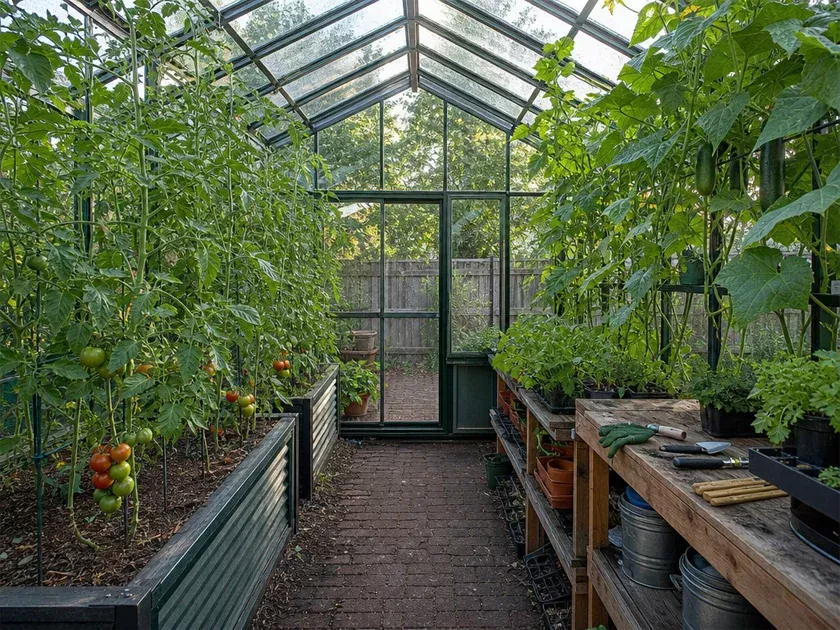
A medium greenhouse with enough width for comfortable beds, access, and propagation space is likely to be more useful than a very small structure.
Example 3: The homesteader
A homesteader may need space for seedlings, production crops, overwintering plants, tools, and seasonal transitions. The greenhouse may serve multiple functions throughout the year.
In this case, additional space can be valuable because several activities may overlap. The decision should still account for the cost and effort required to manage the larger growing environment.
Example 4: The winter grower
A gardener who wants to produce cold-tolerant greens during winter may not need a huge structure simply because winter is involved. Instead, the important questions become how much crop area is required, whether the greenhouse will be heated, how much insulation or environmental control is needed, and how long crops will remain inside.
Winter growing rewards careful planning more than simply adding square footage.
Final Greenhouse Sizing Checklist
Before choosing a greenhouse, make sure you can answer these questions:
- What crops will I grow?
- How large will those crops become?
- Will I grow them in beds, containers, or on benches?
- How many plants do I realistically want?
- How long will plants remain inside?
- Do I need room for seedlings and mature crops simultaneously?
- How wide should the pathways be for comfortable access?
- Do I need shelving, work benches, or storage?
- Where will fans, heaters, irrigation equipment, and other supplies go?
- What are the winter conditions at my location?
- What are the summer heat and ventilation challenges?
- How much sunlight does the proposed site receive?
- Will I use the greenhouse seasonally or year-round?
- Am I likely to expand my greenhouse growing in the next few years?
- Can I comfortably reach and maintain every planting area?
If you can answer these questions before comparing greenhouse models, the correct size usually becomes much easier to identify. Start with the plants and workflow, then choose the structure — not the other way around.
Greenhouse Size FAQ
What is a good greenhouse size for a beginner?
For many beginners, a compact-to-medium greenhouse is easier to manage than a very large structure. A size around 8 × 12 or 9 × 12 feet can provide enough room to learn greenhouse growing without creating an unnecessarily large environmental-management workload. The ideal size still depends on crops and site conditions.
Is a 10 × 10 greenhouse big enough?
A 10 × 10 greenhouse provides 100 square feet of floor area, which can be useful for a focused backyard growing program. The practical capacity depends heavily on your layout. Once beds, paths, shelving, and equipment are included, the actual planting area will be substantially smaller than the total footprint.
Is a 10 × 20 greenhouse big enough for a family garden?
A 10 × 20 greenhouse provides 200 square feet of floor area and can support a substantial home growing operation when efficiently laid out. Whether it is enough depends on how much food you want to produce, which crops you grow, and whether the greenhouse is also being used for seedlings, storage, or winter production.
What greenhouse size is best for tomatoes?
There is no single ideal size for tomatoes. A few determinate varieties can fit comfortably in a relatively small greenhouse, while multiple indeterminate plants require more vertical and horizontal space, support structures, and access. Plan around the mature canopy and the space needed to harvest and maintain the plants.
Does a bigger greenhouse stay warmer?
Not necessarily. Greenhouse temperature depends on solar gain, outdoor temperature, ventilation, insulation, glazing, air movement, shading, heating, and other factors. A larger greenhouse can provide more internal volume, but it also represents a larger environment to manage.
Should I buy the biggest greenhouse I can afford?
Not automatically. A larger greenhouse costs more to purchase and can require more site preparation, environmental control, maintenance, and equipment. Buy enough space to support your actual growing goals with a reasonable margin for future use.
Does USDA Hardiness Zone determine greenhouse size?
No. Hardiness zone is primarily a measure of average annual extreme minimum winter temperature. It can help you understand winter cold, but it does not determine greenhouse size by itself. The crops you grow, the length of your growing season, summer heat, sunlight, and whether you plan to heat the greenhouse all matter as well.
What matters more: greenhouse width or length?
Neither dimension is universally more important. Length can add production area, while width can make a major difference to the number of practical interior layouts available. If you want multiple beds, comfortable paths, shelving, and a work area, pay particular attention to width.
Can a small greenhouse produce a lot of food?
Yes, particularly when you grow productive crops vertically, use succession planting, and make efficient use of the growing season. But intensive production does not eliminate the need for access, air circulation, crop rotation or sanitation, and working space. The goal is productive use of space, not simply maximum plant density.
The Right Greenhouse Size Is the One That Fits Your Growing System
Choosing a greenhouse size becomes much easier when you stop thinking of it as a box measured in feet and start thinking of it as a growing system.
The right size must accommodate mature plants, paths, tools, equipment, seasonal changes, and the way you actually work in the garden. Climate matters. Crop selection matters. Winter plans matter. So does the possibility that your greenhouse will become more important to your garden over time.
For one gardener, that may mean a compact structure dedicated to seedlings and a few summer crops. For another, it may mean a much larger greenhouse capable of supporting several crops, propagation, fall production, and a more intensive food-growing program.
The most useful question is therefore not simply, “How many plants can fit?”
Ask instead: “What do I want this greenhouse to do throughout the year, and how much space will I need to do that comfortably?”
Answer that question first, and the right dimensions will follow.